
Most American organizations have seen digital scheduling change the way their teams plan and collaborate. With over 85 percent of group events now coordinated online, the rise of modern scheduling methods is transforming everything from corporate projects to community gatherings. As technology shapes how people manage time and coordinate with others, understanding these strategies helps groups avoid common conflicts while making planning faster and smarter.
Table of Contents
- Defining Modern Event Scheduling Methods
- How Inverse Scheduling Transforms Planning
- Key Features of Today's Scheduling Tools
- Real-World Uses for Group Coordination
- Benefits and Common Pitfalls to Watch For
Key Takeaways
| Point | Details |
|---|---|
| Modern event scheduling methods | Incorporate advanced strategies like Event Chain Methodology and Discrete-Event Simulation for improved planning efficiency. |
| Inverse scheduling approach | Focus on identifying unavailable time slots first to streamline the planning process and reduce coordination friction. |
| Technological integration | Utilize intelligent scheduling tools that emphasize real-time collaboration, conflict resolution, and user-friendly interfaces for better group coordination. |
| Understanding human dynamics | Effective scheduling requires a balance of technology and an awareness of individual constraints to enhance collaboration. |
Defining Modern Event Scheduling Methods
Modern event scheduling has transformed from traditional manual coordination to sophisticated digital strategies that leverage technology and intelligent methodologies. At its core, event scheduling now represents a dynamic process of managing complex group interactions with precision and efficiency. Understanding contemporary approaches requires examining innovative techniques that go beyond simple date matching.
One key advancement is the emergence of event chain methodology, which extends traditional project scheduling by integrating risk analysis and network interactions. This approach uses advanced techniques like Monte Carlo simulations to generate more realistic and adaptable scheduling frameworks. By mapping potential events and their potential interconnections, planners can create more resilient and flexible event timelines that account for potential disruptions.
Another significant development is discrete-event simulation, which models system operations as a sequence of distinct events occurring at specific moments. Discrete-event simulation allows event organizers to simulate complex scheduling scenarios, predicting potential conflicts and optimizing group availability with unprecedented accuracy. This method enables planners to test multiple scheduling scenarios virtually, reducing the likelihood of logistical challenges before they occur.
The modern landscape of event scheduling emphasizes technological integration, data-driven decision making, and user-friendly interfaces that simplify complex coordination challenges. Platforms now prioritize intuitive design, real-time collaboration, and intelligent conflict resolution mechanisms that streamline group planning across various contexts.
Pro Tip: Strategic Scheduling Approach: Always start your event planning by collecting unavailable dates first, then work backward to find the most universally convenient time slots for all participants.
Here's a comparison of modern event scheduling methodologies:
| Methodology | Key Approach | Typical Use Cases | Unique Advantage |
|---|---|---|---|
| Event Chain | Integrates risk and events | Project management, timelines | Adapts to unexpected disruptions |
| Discrete-Event Sim. | Models events in sequence | Large events, system operations | Predicts and resolves conflicts |
| Inverse Scheduling | Starts with unavailability | Group meetings, manufacturing | Minimizes planning friction |
How Inverse Scheduling Transforms Planning
Inverse scheduling represents a revolutionary approach to group event planning that fundamentally challenges traditional scheduling methods. Unlike conventional techniques that focus on finding common availability, inverse scheduling flips the paradigm by identifying participants' unavailable time slots first, creating a more efficient and user-friendly planning process.

Inverse scheduling strategies excel in scenarios where processing times and participant constraints are complex and dynamic. The methodology addresses challenging coordination problems by allowing planners to work within flexible boundaries, particularly useful when exact availability is difficult to determine. This approach proves especially valuable in complex scheduling environments where traditional methods fall short.
In practical applications, inverse scheduling demonstrates remarkable adaptability across various domains. Manufacturing systems, for instance, can leverage this technique to handle unexpected disruptions without completely redesigning existing schedules. By focusing on unavailable periods, event organizers can quickly identify optimal meeting times that minimize conflicts and maximize overall group participation.
The core innovation of inverse scheduling lies in its user-centric design. Instead of requiring participants to provide specific available times, the method asks individuals to mark their unavailable periods. This subtle shift reduces scheduling friction, simplifies coordination, and empowers groups to find meeting times more intuitively and efficiently.
Pro Tip: Scheduling Efficiency: Always collect unavailability data first, then systematically identify the most universally open time slots to streamline your group planning process.
Key Features of Today's Scheduling Tools
Modern scheduling tools have evolved far beyond simple calendar applications, transforming into intelligent platforms that streamline complex group coordination challenges. Digital scheduling technologies now integrate sophisticated features designed to minimize planning friction and maximize efficiency across diverse organizational and personal contexts.
Several core capabilities distinguish contemporary scheduling solutions. These include real-time collaboration mechanisms, intelligent conflict resolution algorithms, and intuitive user interfaces that simplify multi-participant event planning. Understanding the role of scheduling tools reveals how these platforms have become essential communication bridges that eliminate traditional coordination bottlenecks.
Key technological innovations have dramatically expanded scheduling tool capabilities. Advanced platforms now offer features like automatic time zone conversion, seamless integration with multiple calendar systems, and machine learning algorithms that predict optimal meeting times based on historical participant availability. These smart features transform scheduling from a manual, time-consuming process into an automated, intelligent workflow that adapts to users' unique coordination needs.
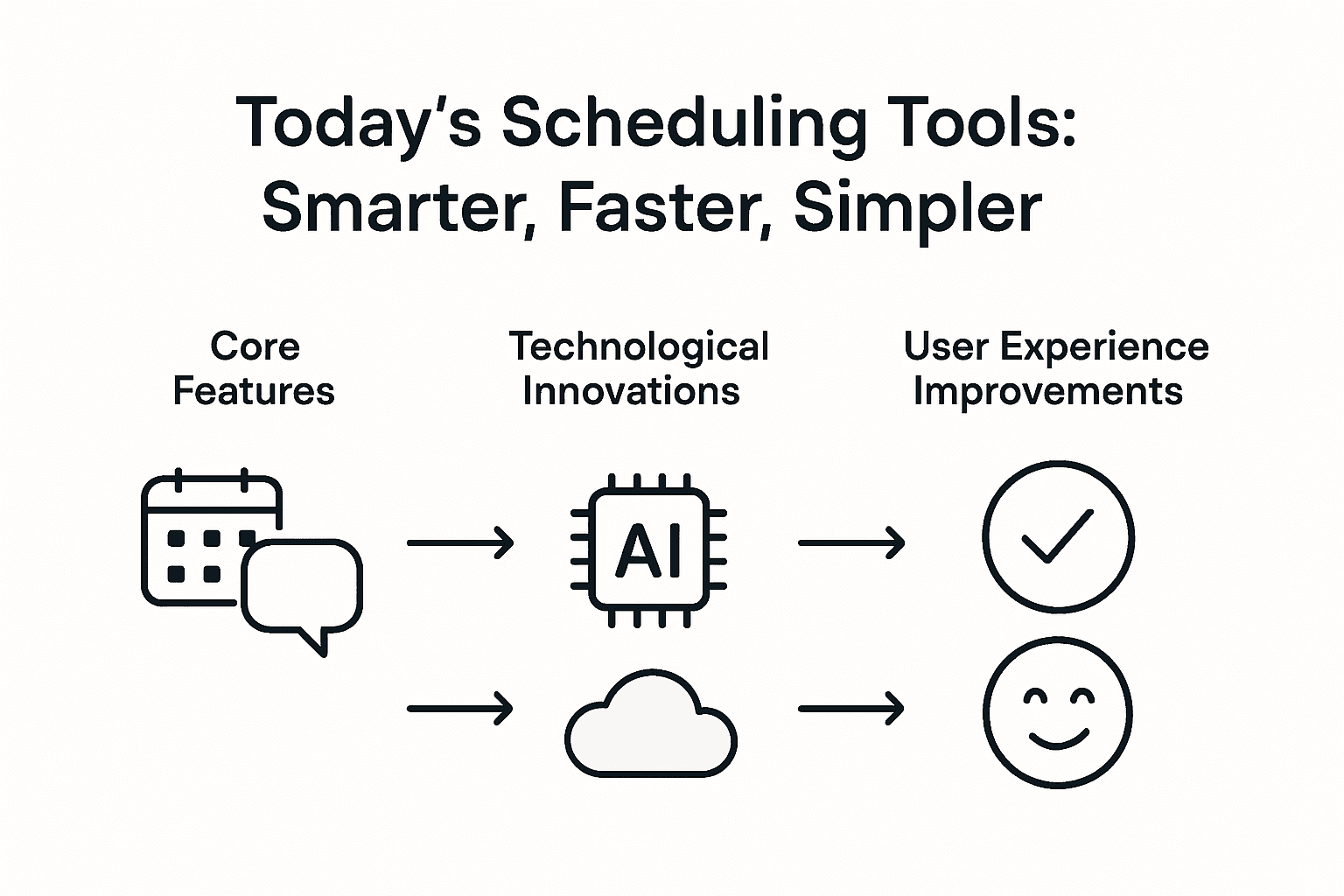
The most effective scheduling tools prioritize user experience and flexibility. They eliminate complex sign-up processes, support anonymous participation, and provide visual representations of group availability that make decision-making transparent and straightforward. By reducing cognitive load and administrative overhead, these tools empower teams and individuals to focus on meaningful collaboration rather than getting bogged down in logistical details.
Pro Tip: Strategic Tool Selection: Evaluate scheduling tools based on your specific group's communication patterns and technological comfort level, not just feature lists.
Real-World Uses for Group Coordination
Group coordination has become an essential skill across numerous professional and personal contexts, transforming how people collaborate and plan complex interactions. Collaborative scheduling now extends far beyond simple meeting arrangements, becoming a critical mechanism for synchronizing diverse group activities and maximizing collective productivity.
Collective scheduling approaches demonstrate remarkable versatility in addressing complex coordination challenges. By integrating advanced decision-making principles, these methodologies help groups navigate intricate scheduling scenarios across various domains - from academic conferences and corporate retreats to community events and family gatherings. The goal is not just finding a mutually acceptable time, but creating schedules that genuinely reflect collective preferences and constraints.
Practical applications of group coordination are particularly evident in educational and professional settings. Parent-teacher conference scheduling exemplifies the nuanced challenges of coordinating multiple stakeholders with competing time constraints. Similar coordination strategies apply to scenarios like medical team shift planning, volunteer organization management, multi-department corporate meetings, and cross-functional project teams where participants have complex availability patterns.
Successful group coordination requires more than technological tools - it demands understanding human dynamics, communication preferences, and individual scheduling constraints. Modern coordination strategies emphasize flexibility, transparency, and minimal friction, allowing groups to spend less time planning and more time accomplishing shared objectives. By prioritizing user experience and intelligent algorithms, these approaches transform scheduling from a logistical challenge into a smooth, collaborative process.
Pro Tip: Coordination Strategy: Always collect individual constraints first, then systematically identify collective opportunities that minimize individual disruption.
Benefits and Common Pitfalls to Watch For
Event scheduling technologies offer tremendous potential for improving group coordination, but understanding both their strengths and potential challenges is crucial for successful implementation. Modern scheduling solutions bring powerful tools that can dramatically streamline planning processes while simultaneously introducing complex dynamics that require careful navigation.
Event-driven architecture reveals both the remarkable advantages and inherent complexities of advanced scheduling systems. These platforms provide high fault tolerance and exceptional performance, enabling groups to manage intricate scheduling scenarios with unprecedented efficiency. However, they also introduce significant testing challenges, requiring planners to carefully balance the granularity and frequency of event processing to prevent system overload.
Modular scheduling approaches demonstrate how flexible coordination methods can simultaneously offer tremendous benefits and potential risks. While these systems encourage individual responsibility and adaptability, they can create coordination challenges that demand meticulous planning. The key is developing strategies that maximize individual flexibility without sacrificing collective coherence and communication.
Successful scheduling implementation requires a nuanced understanding of both technological capabilities and human behavioral patterns. The most effective tools seamlessly integrate advanced algorithms with intuitive user experiences, creating platforms that feel natural and effortless. By anticipating potential friction points and designing systems that proactively address coordination challenges, groups can transform scheduling from a logistical headache into a smooth, collaborative process.
Summary of common benefits and pitfalls with digital scheduling tools:
| Benefit | Pitfall | Mitigation Strategy |
|---|---|---|
| Streamlined group planning | Overwhelming notifications | Adjust notification preferences |
| Automated conflict detection | Platform adoption resistance | Offer training and support |
| Efficient coordination | Data privacy concerns | Use transparent privacy controls |
| Real-time collaboration | Overreliance on technology | Maintain backup communication |
Pro Tip: Strategic Scheduling: Always build redundancy and communication channels into your scheduling approach to mitigate potential coordination breakdowns.
Simplify Your Group Planning with Inverse Scheduling
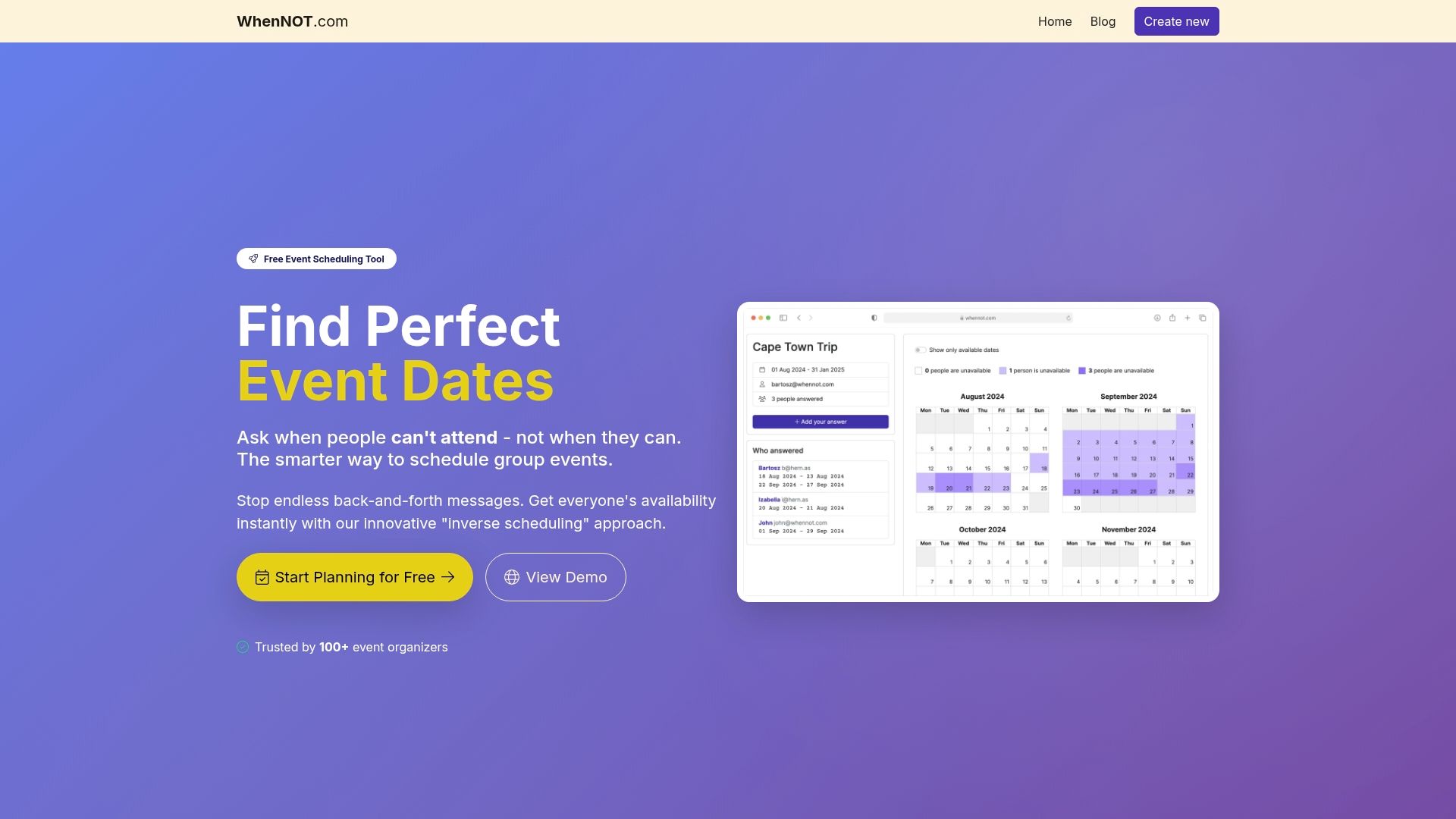
The challenge of coordinating complex group events often comes down to navigating conflicting schedules and hidden availability. This article highlights the power of inverse scheduling as a game-changing strategy that focuses on identifying when participants are unavailable instead of asking for their available times. If you have ever struggled with back-and-forth communications or overwhelming calendar conflicts, you understand how finding a universally convenient time slot can feel impossible.
WhenNOT embraces this innovative approach by offering an intuitive platform where participants mark their busy or unavailable periods without needing to sign up or create accounts. This technique aligns perfectly with the article’s emphasis on reducing scheduling friction and maximizing coordination efficiency. With WhenNOT, you gain visual clarity on everyone’s conflicts at once, empowering you to quickly pinpoint optimal meeting dates for multi-day or flexible events.
Experience the benefits of modern event scheduling today by trying a tool designed to solve the very problems discussed in the article. Unlock faster, smoother group planning and leave frustrating email chains behind.
Streamline your next event effortlessly at WhenNOT and discover how inverse scheduling transforms the way groups coordinate.
Explore How Inverse Scheduling Works
Start Planning with WhenNOT Now
Frequently Asked Questions
What is modern event scheduling?
Modern event scheduling refers to the use of advanced digital strategies and technologies to manage complex group interactions efficiently, moving beyond traditional manual coordination methods.
How does inverse scheduling improve planning?
Inverse scheduling identifies participants' unavailable time slots first, making it easier to find optimal meeting times and reducing coordination friction, particularly in complex scheduling scenarios.
What are the core features of today's scheduling tools?
Contemporary scheduling tools offer features such as real-time collaboration, intelligent conflict resolution, automatic time zone conversion, and machine learning algorithms for predicting optimal meeting times.
What are some common benefits of using digital scheduling technologies?
Digital scheduling technologies streamline group planning, detect conflicts automatically, enable efficient coordination, and enhance real-time collaboration, significantly improving the logistics of scheduling events.