
More than 60 percent of American organizations face challenges when trying to schedule events that fit everyone’s agenda. Whether you are planning a team meeting, an academic symposium, or a family gathering, coordinating multiple schedules puts pressure on even the most organized planners. Understanding the basics of participant scheduling empowers you to work around time zone differences, personal commitments, and group preferences with far greater success.
Table of Contents
- Participant Scheduling Basics And Core Concepts
- Traditional Vs. Inverse Scheduling Methods
- How Inverse Scheduling Streamlines Events
- Key Advantages For Different Groups And Events
- Avoiding Common Participant Scheduling Mistakes
Key Takeaways
| Point | Details |
|---|---|
| Effective Participant Scheduling | Focus on comprehensive participant availability mapping to accommodate diverse schedules and time zones. |
| Inverse Scheduling Advantages | Adopt inverse scheduling techniques to reduce communication complexity and enhance coordination efficiency by marking unavailable times. |
| Common Scheduling Mistakes | Avoid overlooking individual constraints and time zones, and provide ample notice to ensure better attendance and engagement. |
| Utilize Digital Tools | Leverage digital scheduling tools that streamline the process and allow participants to easily indicate their availability. |
Participant Scheduling Basics and Core Concepts
Participant scheduling represents a critical strategic process for coordinating group events, requiring methodical planning and clear communication. The fundamental goal is to find optimal meeting times that accommodate multiple people's availability while minimizing scheduling conflicts. Unlike traditional scheduling approaches that focus solely on finding shared open slots, modern techniques emphasize understanding participants' constraints and preferences.
Effective scheduling begins with comprehensive participant availability mapping. This involves gathering detailed information about potential attendees' time restrictions, considering factors like work schedules, personal commitments, and geographic time zones. Understanding the group scheduling process helps organizers create more flexible and inclusive event planning strategies that respect individual constraints.
Key components of participant scheduling include identifying core scheduling parameters, establishing communication channels, and utilizing collaborative tools that simplify coordination. Organizations like MIT recommend selecting appropriate dates and times that align with participants' schedules and maximize potential attendance. Successful scheduling requires a balanced approach that considers both logistical requirements and individual participant needs.
Pro Planning Tip: Leverage digital scheduling tools that allow participants to mark unavailable times instead of requiring them to confirm availability, reducing communication overhead and simplifying the entire coordination process.
Scheduling Technique: Always provide multiple potential date ranges and clearly communicate expectations, giving participants flexibility and increasing the likelihood of successful event planning.
Traditional vs. Inverse Scheduling Methods
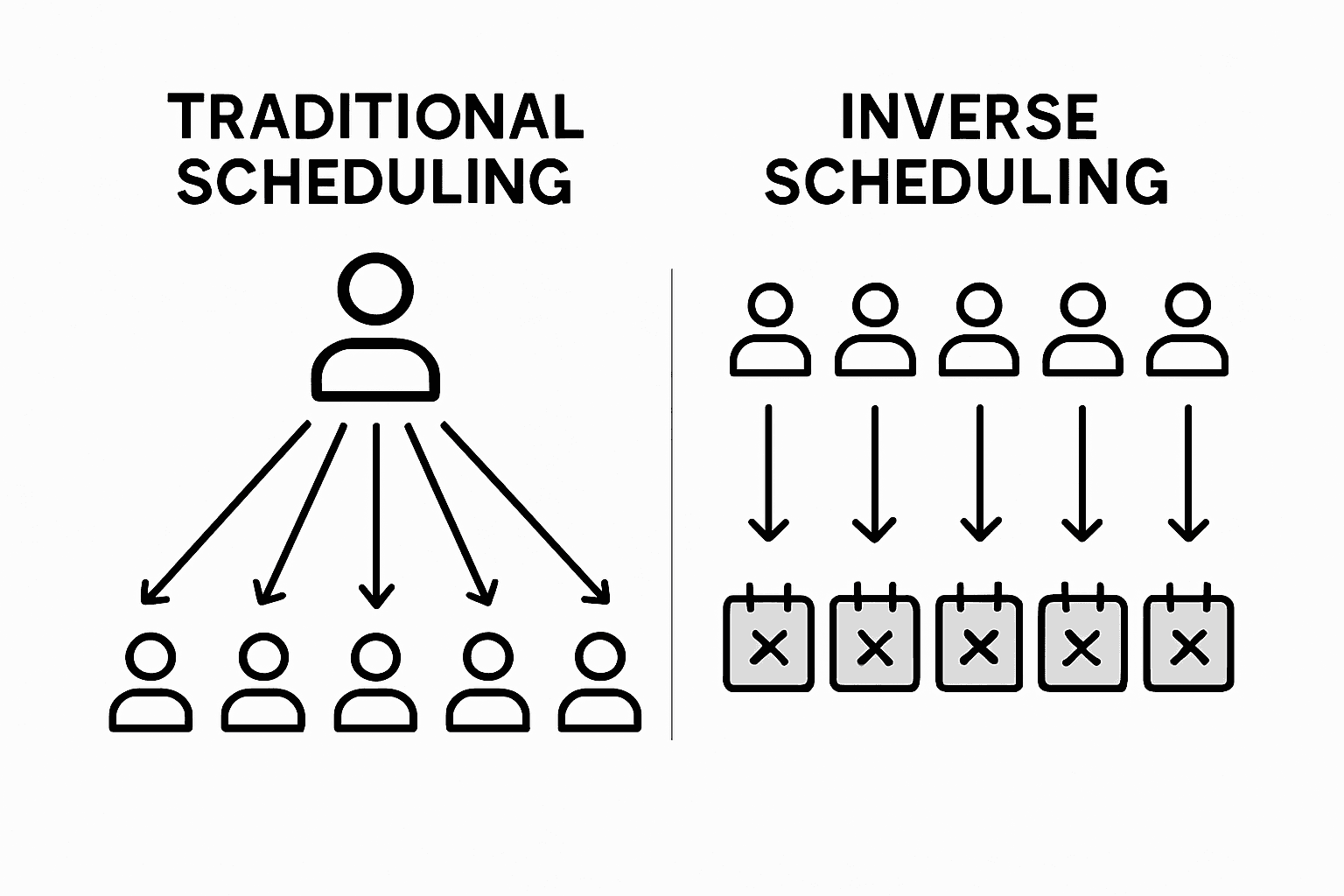
Traditional scheduling methods have long been the standard approach for coordinating group events, typically requiring participants to identify and confirm their specific available time slots. This conventional method often leads to complex communication cycles, multiple email exchanges, and significant coordination overhead. Participants must manually compare schedules, negotiate potential meeting times, and reach a consensus, which can be time-consuming and frustrating.
Inverse scheduling represents a revolutionary alternative that fundamentally changes how availability is determined. Researchers analyzing scheduling techniques highlight that this method focuses on identifying unavailable times instead of available slots, dramatically simplifying the coordination process. By asking participants to mark their restricted time periods, inverse scheduling allows for more efficient and intuitive event planning.
Comparative Scheduling Approaches:
- Traditional Method: Participants confirm available times
- Inverse Method: Participants indicate unavailable times
The key distinction lies in cognitive load and communication efficiency. Event scheduling strategies demonstrate that inverse scheduling reduces decision fatigue by allowing participants to quickly indicate when they cannot attend, rather than struggling to find perfect shared windows. This approach is particularly beneficial for multi-day events, complex group coordination, and scenarios with numerous scheduling constraints.
Pro Scheduling Strategy: Implement inverse scheduling techniques that allow participants to mark unavailable times quickly, reducing communication complexity and increasing the likelihood of successful event coordination.
Scheduling Efficiency Tip: Always provide clear instructions and a simple mechanism for participants to indicate their time restrictions, making the scheduling process more user-friendly and streamlined.
Here is a concise comparison of traditional and inverse scheduling methods:
| Criteria | Traditional Scheduling | Inverse Scheduling |
|---|---|---|
| Participant Task | Identify available times | Mark unavailable periods |
| Communication Effort | Multiple back-and-forth emails | Fewer, streamlined interactions |
| Complexity for Groups | High for large groups | Lower even with many members |
| Ease of Use | Can be confusing | More intuitive for most users |
| Risk of Overlap | High due to varied confirmations | Reduced through conflict removal |
How Inverse Scheduling Streamlines Events
Inverse scheduling represents a transformative approach to event coordination that dramatically reduces the complexity of traditional planning methods. By shifting the focus from identifying available times to marking unavailable periods, this innovative technique simplifies the entire scheduling process. Advanced scheduling research demonstrates how this method optimizes event planning by minimizing cognitive load and communication barriers.

The core advantage of inverse scheduling lies in its intuitive approach to time management. Participants can quickly indicate their restricted time periods, allowing event organizers to rapidly identify potential meeting windows. Cognitive efficiency becomes the primary benefit, as people find it significantly easier to recall and mark times they cannot attend, rather than attempting to pinpoint precise available slots. This approach is particularly powerful for complex scheduling scenarios involving multiple participants with diverse commitments.
Technological innovations are further enhancing inverse scheduling capabilities. Adaptive scheduling models now leverage advanced algorithms that dynamically process participant constraints, enabling more intelligent and flexible event planning. These systems can quickly analyze multiple scheduling inputs, reducing the time and effort required to coordinate group events across different time zones, work schedules, and personal commitments.
Scheduling Complexity Reduction:
- Traditional Method: Manually matching available times
- Inverse Method: Quickly eliminating unavailable periods
- Result: Faster, more efficient event coordination
Pro Scheduling Insight: Implement inverse scheduling techniques that allow participants to mark unavailable times with minimal effort, transforming complex coordination challenges into streamlined planning processes.
Efficiency Strategy: Communicate clear, simple instructions for marking unavailable times, empowering participants to contribute to scheduling with minimal cognitive overhead.
Key Advantages for Different Groups and Events
Participant scheduling methods vary dramatically across different group contexts, requiring nuanced approaches tailored to specific event types and organizational needs. Advanced group decision models demonstrate how contextual information can significantly enhance scheduling efficiency, allowing more precise coordination across diverse event scenarios from corporate meetings to family reunions.
Different group types benefit uniquely from inverse scheduling techniques. Corporate teams can streamline multi-participant meeting coordination, reducing time spent on email exchanges and calendar comparisons. Academic research groups find this approach particularly valuable when coordinating complex schedules involving researchers with varied commitments. Social groups and hobby clubs can effortlessly plan gatherings by quickly identifying shared unavailable periods, making event planning more inclusive and less stressful.
Social-temporal group query research reveals sophisticated strategies for optimizing group event planning by considering not just availability, but also social relationships and proximity. Scheduling Optimization Scenarios include:
- Professional Conferences: Coordinating speaker and attendee schedules
- Family Reunions: Managing diverse geographic and time zone challenges
- Academic Collaborations: Connecting researchers across different institutions
- Community Events: Organizing volunteer and participant availability
Technology continues to transform group scheduling, enabling more intelligent and adaptive coordination methods that respect individual constraints while facilitating collective planning.
Pro Event Planning Insight: Prioritize scheduling approaches that minimize individual cognitive load, allowing participants to communicate unavailability with minimal effort and maximum clarity.
Strategic Coordination Tip: Develop a flexible scheduling framework that acknowledges the unique time constraints of different participant groups, creating a more inclusive and efficient planning process.
Avoiding Common Participant Scheduling Mistakes
Participant scheduling requires strategic planning to prevent common pitfalls that can derail event coordination. Event management best practices emphasize the critical importance of understanding potential scheduling challenges before they impact participant engagement and overall event success.
Major Scheduling Mistake Categories:
- Ignoring Time Zone Differences
- Failing to Provide Sufficient Notice
- Overlooking Individual Schedule Constraints
- Not Offering Flexible Participation Options
One of the most frequent errors is assuming all participants have identical availability and scheduling flexibility. Comprehensive event planning guidelines highlight the necessity of considering diverse participant backgrounds, work schedules, and personal commitments when coordinating group events. This means moving beyond simple time slot selection and adopting more nuanced scheduling approaches that respect individual constraints.
Technology can help mitigate scheduling risks by providing advanced coordination tools that accommodate complex availability scenarios. Inverse scheduling techniques, which allow participants to mark unavailable times, represent a significant improvement over traditional methods. These approaches reduce communication overhead, minimize scheduling conflicts, and create a more inclusive planning environment that respects participants' time and individual constraints.
Pro Scheduling Alert: Always communicate multiple potential time options and provide clear, transparent scheduling guidelines that allow participants to indicate their constraints easily and comfortably.
Strategic Planning Tip: Implement flexible scheduling methods that prioritize participant convenience, recognize diverse time constraints, and minimize potential coordination friction.
The table below summarizes common mistakes and strategies to prevent them in participant scheduling:
| Scheduling Mistake | Consequence | Prevention Strategy |
|---|---|---|
| Ignoring Time Zones | Missed or late attendance | Specify time zones in all invites |
| Providing Short Notice | Low participant turnout | Share event details well in advance |
| Overlooking Personal Constraints | Frustration and conflicts | Collect restrictions before planning |
| Limited Participation Options | Excludes some participants | Offer multiple scheduling alternatives |
Simplify Your Group Event Planning with Smart Scheduling Solutions
Managing participant scheduling challenges such as conflicting availability, cognitive overload, and complicated communication is tough. This article highlights how traditional scheduling demands people to confirm available slots while causing frustration and delay. The innovative concept of inverse scheduling minimizes complexity by letting participants mark when they are unavailable. If you are looking to reduce scheduling headaches and streamline coordination for multi-day or flexible events, understanding and applying inverse scheduling is a game changer.
WhenNOT is designed precisely for this modern approach. It empowers organizers to avoid endless back-and-forth by letting attendees indicate their busy times quickly and effortlessly. With an easy-to-use platform requiring no sign-up, WhenNOT visualizes everyone's unavailable periods in one place making it faster to find the best fit for your group. Whether you manage corporate meetings, family reunions, or social events, this tool offers a free, secure, and accessible way to minimize conflicts and maximize attendance.
Discover how inverse scheduling can transform your planning and experience the simplicity of marking unavailability instead of availability.
Start your next event effortlessly with WhenNOT and take the stress out of participant scheduling today.
Learn more about innovative scheduling processes and elevate your event coordination to the next level.
Frequently Asked Questions
What is participant scheduling?
Participant scheduling is the process of coordinating group events by finding optimal meeting times that accommodate multiple people's availability while minimizing scheduling conflicts.
How does inverse scheduling differ from traditional scheduling methods?
Inverse scheduling focuses on identifying participants' unavailable times rather than their available slots, simplifying the coordination process and reducing communication overhead.
What are the advantages of using digital scheduling tools?
Digital scheduling tools allow participants to mark unavailable times quickly, reducing communication complexity, minimizing scheduling conflicts, and streamlining the entire planning process.
What are some common mistakes to avoid in participant scheduling?
Common mistakes include ignoring time zone differences, failing to provide sufficient notice, overlooking individual schedule constraints, and not offering flexible participation options.
Recommended
- 6 Ways to Simplify Scheduling for Events Easily - WhenNOT Blog
- Understanding the Group Scheduling Process for Events - WhenNOT Blog
- Mastering Best Group Scheduling Practices for 2025 - WhenNOT Blog
- How to Optimize Event Scheduling for Fast, Hassle-Free Planning - WhenNOT Blog
- Understanding Event Planning 101 for Special Occasions - DressMeUpNY
- Ventajas de viajar en grupo: descubre todos sus beneficios
- Cómo poner en marcha el módulo de ausencias y vacaciones