
Over half of American event organizers say scheduling is the toughest part of planning a group activity. When every team member or family has their own commitments, finding a time that works for all can become a logistical puzzle. Crowd-sourced scheduling tools offer a smarter way to tackle these challenges by letting everyone share their constraints, turning coordination into a truly collaborative process with proven time-saving results.
Table of Contents
- Defining Crowd-Sourced Scheduling in Event Planning
- Types of Crowd-Sourced Scheduling Approaches
- How Inverse Scheduling Simplifies Coordination
- Benefits and Challenges for Organizers
- Comparing Crowd-Sourced Tools With Traditional Methods
Key Takeaways
| Point | Details |
|---|---|
| Crowd-Sourced Scheduling Empowers Participation | This approach allows participants to collaboratively contribute their scheduling preferences, enhancing engagement and decision-making. |
| Inverse Scheduling Simplifies Coordination | By focusing on participants' unavailable times, this method streamlines the process of finding mutually convenient meeting times. |
| Maintaining Data Quality is Crucial | Organizers must develop robust strategies to ensure reliable participation and accurate scheduling results. |
| Hybrid Models Offer Enhanced Performance | Combining crowd-sourcing with traditional methods can improve adaptability and efficiency in scheduling. |
Defining Crowd-Sourced Scheduling in Event Planning
Crowd-sourced scheduling represents a collaborative approach to event planning that harnesses collective intelligence to solve complex timing challenges. Unlike traditional scheduling methods where a single organizer determines availability, this strategy empowers participants to collectively contribute their scheduling constraints and preferences. Crowdsourcing platforms enable diverse participant engagement by facilitating rapid, affordable recruitment from varied backgrounds.
At its core, crowd-sourced scheduling transforms event coordination from a top-down process into a democratic, participatory experience. Participants can self-select their availability windows, input potential conflicts, and collaboratively identify optimal meeting times or event dates. This approach recognizes that modern scheduling requires flexibility, considering individual constraints across professional and personal calendars.
The mechanism typically involves digital platforms where event organizers share a proposed date range, and participants mark their unavailable periods. By inverting the traditional availability-based approach, crowd-sourced scheduling focuses on identifying when people cannot attend, thereby simplifying the complex task of finding mutually convenient times. Effective crowd scheduling demands strategic coordination efforts that motivate widespread participation and ensure timely contributions.
Pro tip: When implementing crowd-sourced scheduling, create clear instructions and set specific deadlines to maximize participant engagement and streamline the decision-making process.
Types of Crowd-Sourced Scheduling Approaches
Crowd-sourced scheduling encompasses multiple strategic approaches designed to solve complex timing challenges through collective participation. Crowdsourcing methods vary significantly by task complexity, ranging from simple availability marking to sophisticated collaborative problem-solving techniques. These approaches can be broadly categorized into distinct models that adapt to different event planning scenarios and participant engagement levels.
The primary types of crowd-sourced scheduling include open innovation challenges, collaborative consensus building, and microtask-based approaches. Open innovation challenges invite participants to compete in developing optimal scheduling solutions, encouraging creative problem-solving. Collaborative consensus building focuses on group members jointly negotiating and refining potential scheduling options, emphasizing collective decision-making. Microtask approaches break down scheduling into smaller, manageable tasks that individual participants can quickly complete, making large-scale coordination more accessible.
Crowd scheduling models integrate different participant expertise levels and communication strategies. Some approaches rely on volunteer data collection, where participants contribute availability information voluntarily, while others implement more structured frameworks with specific guidelines and communication protocols. The selection of an appropriate scheduling approach depends on factors like group size, event complexity, participant diversity, and the specific coordination goals.
Here's a summary of the main crowd-sourced scheduling approaches and their practical applications:
| Approach Type | Coordination Style | Best Use Cases | Participant Engagement |
|---|---|---|---|
| Open Innovation | Competitive solution | Large-scale conferences | Highly creative |
| Collaborative Consensus | Joint negotiation | Team meetings, family events | Focused discussion |
| Microtask-Based | Task deconstruction | Volunteer data collection | Quick participation |
Pro tip: Select a crowd-sourced scheduling approach that matches your group's communication style and technical comfort level to maximize participation and scheduling efficiency.
How Inverse Scheduling Simplifies Coordination
Inverse scheduling represents a revolutionary approach to group coordination that fundamentally transforms how event planners solve complex availability challenges. Inverse optimization techniques simplify coordination by working backward from known scheduling constraints to understand and predict optimal meeting times. This method flips traditional scheduling logic, focusing on identifying when participants cannot meet rather than forcing them to declare when they can.
The core principle of inverse scheduling involves analyzing existing scheduling patterns to infer underlying preferences and constraints. Instead of requiring participants to manually select available time slots, this approach automatically detects potential conflicts and suggests alternative scheduling options. Scheduling models optimize coordination dynamically by identifying minimal adjustments needed to accommodate group availability, making the entire process more flexible and user-friendly.

Practical applications of inverse scheduling span various contexts, from corporate team meetings to academic group projects and family event planning. By understanding the inherent constraints and preferences of participants, organizers can create more intelligent and adaptive scheduling strategies. The technique allows for more nuanced coordination, recognizing that availability is rarely a binary yes or no proposition, but a complex interplay of individual schedules and commitments.
Pro tip: Leverage inverse scheduling techniques by focusing on participants' unavailable times rather than forcing them to identify precise availability windows.
Benefits and Challenges for Organizers
Crowd-sourced scheduling brings significant advantages and complex challenges for event organizers seeking efficient coordination strategies. Crowd scheduling offers multiple organizational benefits including unprecedented scalability, diverse input collection, and potential cost reductions compared to traditional scheduling methods. By enabling flexible participant engagement, these approaches can dramatically accelerate decision-making timelines and expand collaborative potential.
The key benefits include enhanced problem-solving creativity, broader participant outreach, and increased data volume and diversity. Organizers gain access to collective intelligence that transcends traditional scheduling limitations. However, these advantages are counterbalanced by critical challenges such as maintaining data quality, managing unequal participation levels, and developing robust validation mechanisms to prevent potential scheduling conflicts.
Scientific crowdsourcing requires careful participant management to ensure reliable outcomes. Successful organizers must implement strategic approaches that balance open participation with rigorous quality control. This involves creating clear participation guidelines, establishing fair recognition systems, and developing mechanisms to handle potentially biased or unreliable participant inputs. The most effective crowd-sourced scheduling strategies transform these challenges into opportunities for more dynamic and inclusive event coordination.
Pro tip: Design your crowd-sourced scheduling approach with transparent rules and clear incentives to maximize participant engagement and input quality.
Comparing Crowd-Sourced Tools With Traditional Methods
Traditional scheduling methods have long relied on centralized decision-making processes, but computational scheduling approaches are transforming coordination strategies. These innovative tools fundamentally differ from conventional techniques by introducing dynamic, adaptive mechanisms that respond in real-time to participant availability and changing circumstances. Where traditional methods often require manual intervention and suffer from inflexibility, crowd-sourced scheduling leverages collective intelligence to streamline complex coordination challenges.
The key distinctions between crowd-sourced and traditional scheduling tools emerge across multiple dimensions. Traditional methods typically depend on a single coordinator or expert managing availability, whereas crowd-sourced approaches distribute decision-making across participants. Hybrid scheduling models offer significant performance improvements by combining domain expertise with scalable, cost-efficient technologies. These innovative tools can process larger volumes of scheduling data, adapt more quickly to changing constraints, and provide more nuanced insights into group availability patterns.
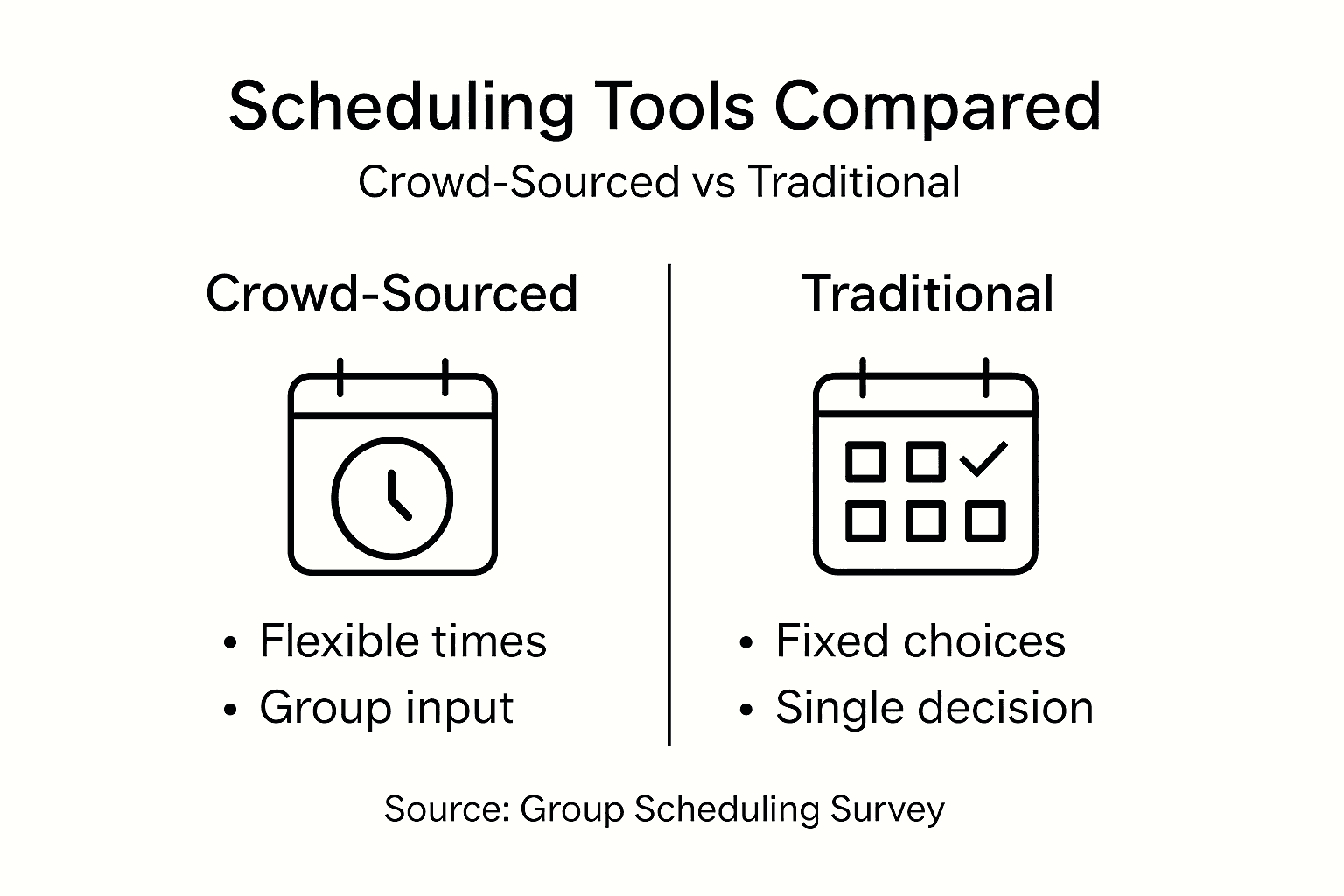
The table below compares key features of crowd-sourced scheduling tools versus traditional scheduling methods:
| Criteria | Crowd-Sourced Tools | Traditional Methods |
|---|---|---|
| Decision-Making | Distributed among participants | Centralized organizer control |
| Adaptability | Updates in real time | Manual adjustments required |
| Data Processing | Handles complex inputs efficiently | Limited by human oversight |
| Inclusiveness | Democratic, participant-driven | Often overlooks constraints |
Performance metrics clearly demonstrate the advantages of crowd-sourced scheduling. These tools consistently demonstrate lower processing times, enhanced resource utilization, and greater flexibility compared to rigid traditional scheduling approaches. By enabling participants to contribute their constraints and preferences directly, crowd-sourced methods create more democratic, transparent scheduling processes that account for individual complexities often overlooked by conventional techniques.
Pro tip: Evaluate scheduling tools by comparing their adaptability, participant engagement features, and ability to handle complex availability scenarios.
Simplify Your Crowd-Sourced Scheduling with WhenNOT
Managing group availability and coordinating event dates can feel overwhelming when relying on traditional methods. This article highlights how crowd-sourced scheduling and the inverse scheduling approach can ease the process by focusing on participants' unavailable times rather than their available slots. If you want to maximize participation, reduce endless back-and-forth communication, and streamline your event planning, adopting a tool that embraces these principles is essential.
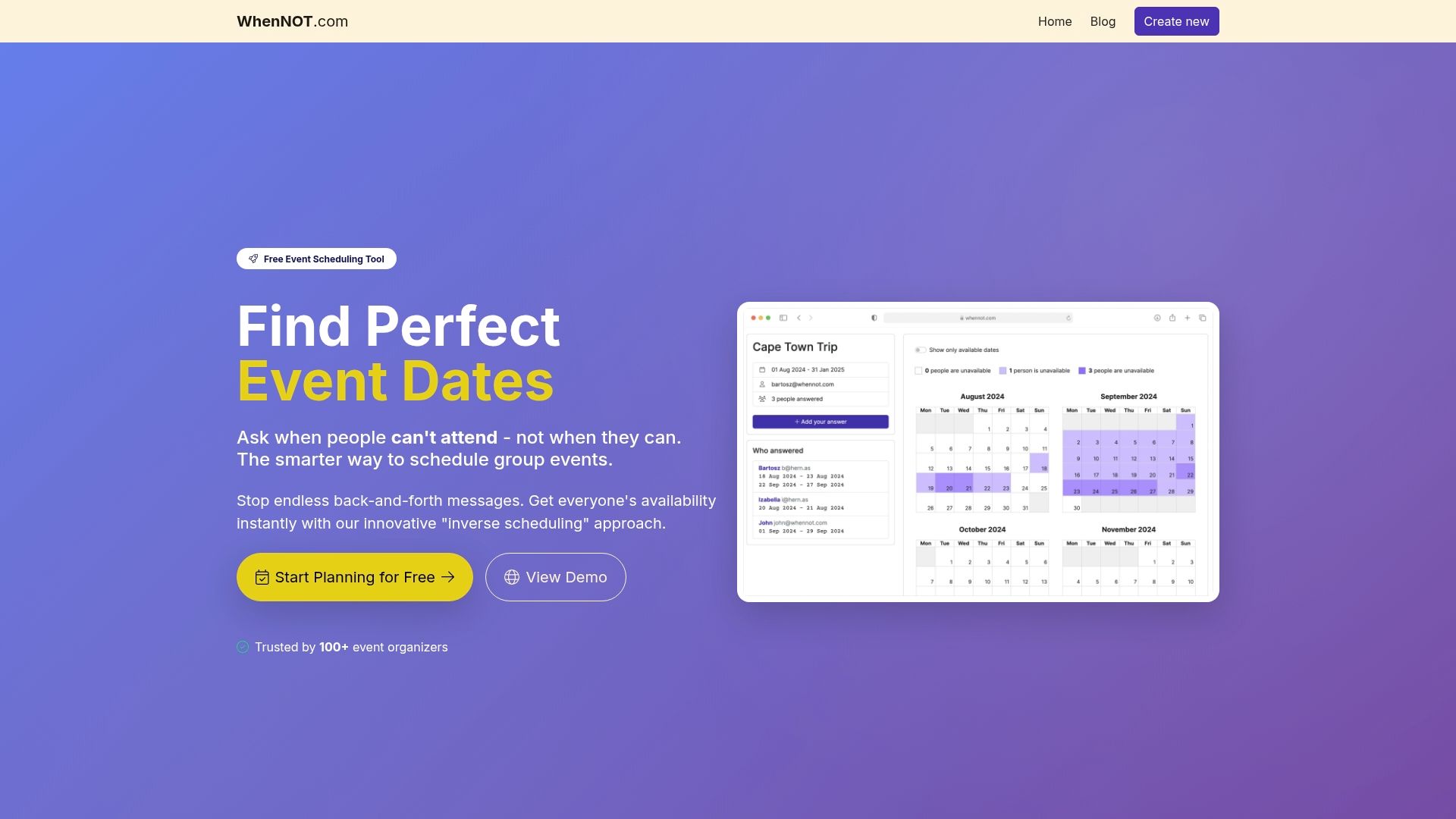
Experience the power of WhenNOT, an innovative online scheduling platform designed specifically to tackle the challenges discussed in this article. By asking participants to mark only when they are not available across multi-day ranges, WhenNOT saves you time, avoids scheduling conflicts, and respects privacy without requiring signups. Whether planning family gatherings, corporate events, or group travel, WhenNOT offers a free, user-friendly, and efficient solution that harnesses the benefits of crowd-sourced scheduling with inverse scheduling techniques. Start transforming how you coordinate group events today by visiting WhenNOT and see how easy scheduling can be. Discover more about adaptive group coordination with effective crowd-sourced scheduling strategies and embrace smarter event planning now.
Frequently Asked Questions
What is crowd-sourced scheduling?
Crowd-sourced scheduling is a collaborative approach to event planning that allows participants to contribute their scheduling constraints and preferences, rather than relying on a single organizer to determine availability.
How does inverse scheduling work?
Inverse scheduling focuses on identifying when participants cannot meet and uses this information to suggest optimal meeting times, simplifying the scheduling process by analyzing existing constraints and preferences.
What are the benefits of using crowd-sourced scheduling?
Using crowd-sourced scheduling offers enhanced problem-solving creativity, broader participant outreach, and increased data diversity while accelerating decision-making timelines and fostering collaboration.
What challenges might organizers face with crowd-sourced scheduling?
Organizers may encounter challenges such as maintaining data quality, managing unequal participation levels, and ensuring robust validation mechanisms to avoid scheduling conflicts.
Recommended
- Understanding Group Availability: A Guide to Coordination - WhenNOT Blog
- Mastering Best Group Scheduling Practices for 2025 - WhenNOT Blog
- Understanding Group Scheduling Guide for Effortless Planning - WhenNOT Blog
- Understanding Group Scheduling Explained for Easy Coordination - WhenNOT Blog
- Scheduling Production Planning and Control for Film Shoots
- 7 Essential Tips for Stress-Free Group Airport Transfer