
Over half of American corporate retreat organizers report that traditional RSVP methods create unnecessary stress and scheduling delays. Planning multi-day events across North America often means navigating countless calendars and privacy concerns, especially when every participant values discretion. RSVP-free scheduling offers a smarter path, helping you cut planning time while keeping simplicity and participant privacy front and center.
Table of Contents
- RSVP-Free Scheduling Explained Clearly
- How Inverse Scheduling Differs From Traditional Tools
- Privacy, Accessibility, And User Experience
- Real-World Uses For Corporate Retreats
- Pitfalls To Avoid With RSVP-Free Platforms
Key Takeaways
| Point | Details |
|---|---|
| RSVP-Free Scheduling | This method simplifies scheduling by allowing participants to indicate unavailability rather than requiring confirmations, reducing communication overload. |
| Efficiency Gains | RSVP-free scheduling can cut coordination time significantly, with reports indicating reductions of up to 60% in scheduling complexity. |
| User Experience | Modern platforms prioritize privacy and accessibility, offering intuitive interfaces that require minimal data entry and build participant confidence. |
| Potential Challenges | Organizations must provide clear communication on the scheduling process to avoid misinterpretation and ensure effective use of the tools. |
RSVP-Free Scheduling Explained Clearly
RSVP-free scheduling represents a revolutionary approach to coordinating group events by eliminating traditional confirmation barriers. Unlike conventional methods that require participants to formally respond to invitations, this innovative strategy focuses on identifying collective availability through an inverse scheduling technique. Scheduling optimization research demonstrates how this method can significantly reduce communication overhead and scheduling complexity.
The core principle behind RSVP-free scheduling is simplicity. Instead of asking participants when they are available, the approach flips the traditional model by allowing individuals to mark their unavailable dates. This subtle shift transforms the entire scheduling dynamic, enabling more efficient and stress-free event coordination. By removing the pressure of mandatory responses, participants can engage with scheduling tools more casually and transparently.
Key advantages of RSVP-free scheduling include increased participant flexibility, reduced communication friction, and faster decision-making. Corporate retreat organizers can particularly benefit from this approach, as it accommodates diverse schedules and eliminates the exhausting back-and-forth email chains typically associated with event planning. Scheduling best practices suggest that tools enabling participants to indicate unavailability can cut scheduling time by up to 60%.
Pro tip: When implementing RSVP-free scheduling, communicate the process clearly to participants and emphasize the simplicity of marking unavailable dates to encourage maximum engagement.
Here's how RSVP-free scheduling compares to traditional methods:
| Aspect | Traditional Scheduling | RSVP-Free Scheduling |
|---|---|---|
| Participant Effort | Requires confirming dates | Marks only unavailable dates |
| Communication Overhead | High, many email exchanges | Low, streamlined responses |
| Decision Speed | Often slow | Significantly faster |
| User Pressure | High, formal RSVPs needed | Low, casual participation |
How Inverse Scheduling Differs From Traditional Tools
Inverse scheduling fundamentally transforms group event planning by completely reversing the traditional scheduling paradigm. Where conventional tools require participants to confirm availability through formal RSVPs, advanced scheduling algorithms instead focus on identifying collective unavailability. This innovative approach shifts the entire coordination process from reactive confirmation to proactive preference mapping.
Traditional scheduling methods typically involve multiple email exchanges, endless calendar comparisons, and the frustrating process of aligning individual schedules. In contrast, inverse scheduling streamlines this process by allowing participants to simply mark dates they cannot attend. The system then automatically identifies optimal time slots that work for the maximum number of participants. Scheduling optimization research demonstrates that this method can reduce scheduling complexity by eliminating the back-and-forth communication typically required.

The key differentiation lies in the approach to participant preferences. Traditional tools demand explicit confirmations and create pressure for immediate responses, while inverse scheduling provides a more flexible, low-pressure environment. Corporate teams and event organizers can benefit from this approach, as it accommodates diverse schedules and reduces the administrative burden of coordinating multiple participants. By focusing on unavailability rather than availability, these innovative tools create a more efficient and user-friendly scheduling experience.
Pro tip: When implementing inverse scheduling, communicate the process clearly to participants and emphasize how marking unavailable dates is quicker and easier than traditional RSVP methods.
Privacy, Accessibility, and User Experience
Privacy and user experience are critical components of modern scheduling platforms, especially those utilizing inverse scheduling methods. Smart scheduling systems have revolutionized how participant data is managed, ensuring robust protection while maintaining seamless accessibility. Unlike traditional scheduling tools that require extensive personal information, RSVP-free platforms prioritize minimal data collection and user control.
Accessibility goes beyond technical design in these innovative scheduling solutions. The primary goal is creating an interface that eliminates barriers for participants with diverse technological backgrounds and capabilities. By removing complex registration processes and simplifying date selection, these tools democratize event coordination. RSVP tool features demonstrate how modern platforms can balance comprehensive functionality with intuitive user experiences, allowing participants to engage without feeling overwhelmed by technical complexity.
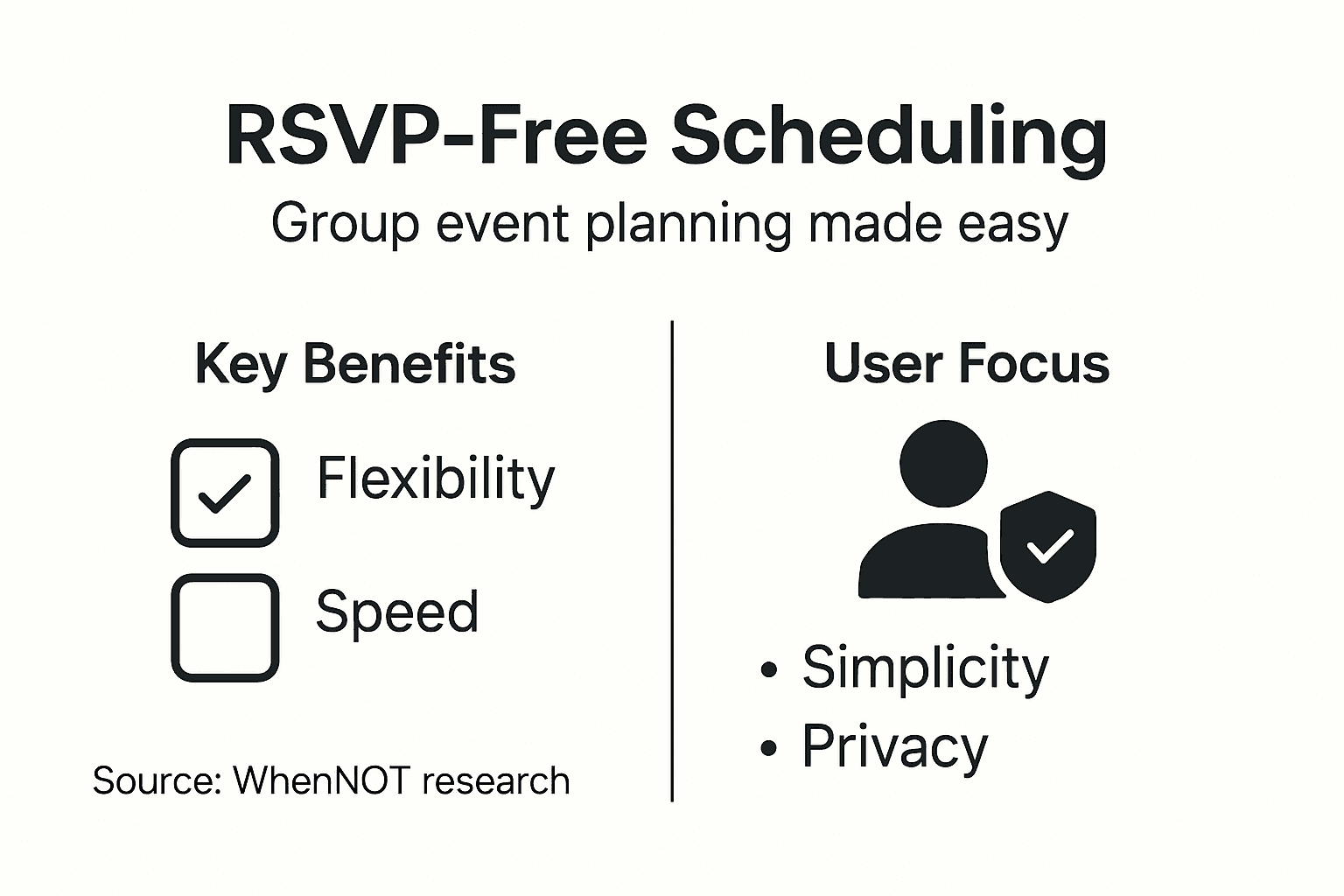
Data security remains paramount in these systems. Advanced scheduling platforms implement multi-layered privacy protections, including end-to-end encryption, anonymized data handling, and transparent user consent mechanisms. Corporate event organizers can confidently use these tools, knowing participant information remains protected while facilitating efficient scheduling. The emphasis is on creating a frictionless experience that respects individual privacy preferences and reduces administrative overhead simultaneously.
Pro tip: Always review the privacy settings of your scheduling platform and communicate data handling practices transparently to build participant trust.
Key privacy and accessibility features found in modern RSVP-free scheduling platforms:
| Feature | Business Impact | User Benefit |
|---|---|---|
| Minimal Data Entry | Reduces risk and admin burden | Easier and faster to use |
| End-to-End Encryption | Protects sensitive information | Builds participant confidence |
| Simple Interfaces | Broadens potential user base | More accessible for all |
| Transparent Consent | Enhances regulatory compliance | Clear understanding of privacy |
Real-World Uses for Corporate Retreats
Corporate retreats serve as powerful strategic tools for team building, strategic planning, and organizational development. Corporate event scheduling requires meticulous planning to ensure maximum engagement and productivity. These multi-day events provide unique opportunities for teams to step outside their regular work environment, fostering deeper connections, alignment, and collaborative problem-solving that cannot be achieved through standard office interactions.
Typical corporate retreat objectives vary widely, but often include critical organizational goals such as strategic alignment, team cohesion, skill development, and innovative thinking. Organizations might design retreats around specific outcomes like developing next year's business strategy, introducing new company initiatives, conducting leadership workshops, or facilitating cross-departmental collaboration. By removing participants from their daily work context, companies create space for more open dialogue, creative thinking, and meaningful relationship building that transcends typical workplace hierarchies and communication patterns.
Successful corporate retreats typically incorporate a blend of structured sessions and informal networking opportunities. This might include workshop-style presentations, team-building activities, collaborative brainstorming sessions, skill development workshops, and dedicated time for personal reflection and interdepartmental interactions. The key is creating an environment that balances professional development with genuine human connection, allowing team members to engage authentically while advancing organizational objectives. Inverse scheduling tools become particularly valuable in coordinating these complex, multi-day events with participants from diverse locations and schedules.
Pro tip: Design your corporate retreat agenda with intentional flexibility, allowing sufficient unstructured time for organic conversations and relationship building alongside formal programming.
Pitfalls to Avoid With RSVP-Free Platforms
Interview scheduling challenges reveal critical nuances in RSVP-free platforms that can derail event coordination if not carefully managed. While these innovative tools promise streamlined scheduling, organizations must navigate potential pitfalls that could compromise their event planning effectiveness. Understanding these potential issues allows teams to implement more robust scheduling strategies and minimize coordination complications.
One significant risk involves participant communication and expectation management. RSVP-free platforms require clear instructions and intuitive interfaces to ensure participants understand how to mark their unavailable dates. Without precise guidance, users might misinterpret the scheduling process, leading to incomplete or inaccurate availability data. Organizations must invest time in creating straightforward communication protocols that explain the inverse scheduling approach, ensuring all participants can effectively use the platform without confusion.
Technical limitations and algorithmic constraints represent another potential challenge with RSVP-free scheduling tools. Some platforms might struggle with complex scheduling scenarios involving multiple time zones, conflicting participant preferences, or intricate availability patterns. Corporate teams must carefully evaluate scheduling platforms, ensuring the chosen solution can handle their specific event requirements. Scheduling platform comparisons can help identify tools with robust features that minimize potential coordination errors and provide flexible scheduling capabilities.
Pro tip: Always conduct a test run with a small group before implementing an RSVP-free scheduling platform for a large corporate event to identify and address potential user experience challenges.
Simplify Your Group Event Planning with RSVP-Free Scheduling
The challenge of coordinating multiple schedules without endless back-and-forth communication is real. If you want to reduce participant pressure, eliminate confusing RSVP requests, and speed up decision-making for multi-day or flexible events, RSVP-free scheduling is the answer. This approach lets participants mark only when they are unavailable, creating a straightforward way to find the best dates for corporate retreats, family gatherings, or any group event.
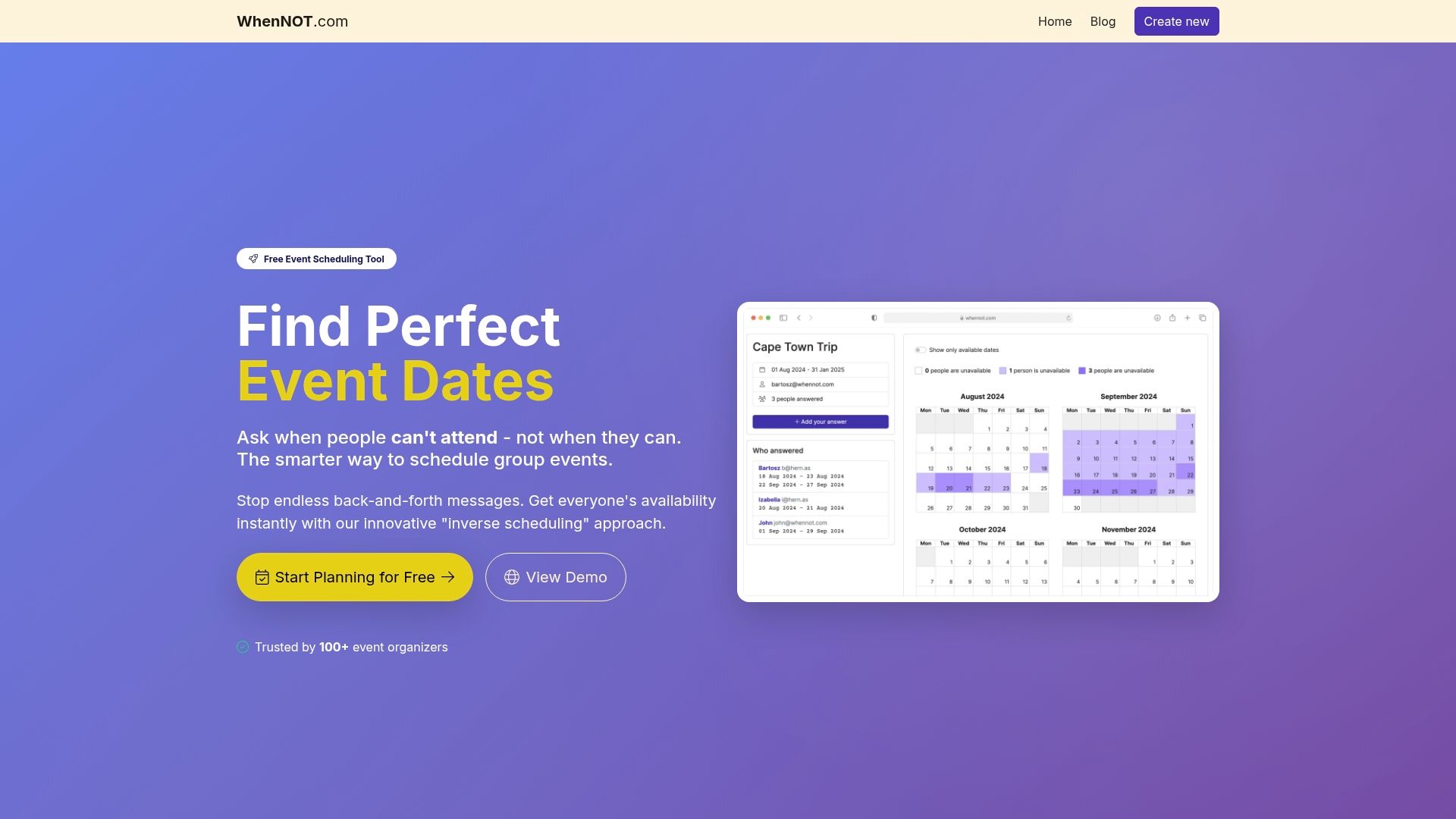
Experience the power of inverse scheduling firsthand with WhenNOT. Our platform embraces the RSVP-free method by letting your guests indicate busy days quickly and easily without signing up or confirming availability formally. Designed for privacy, simplicity, and accessibility, WhenNOT helps you visualize everyone’s unavailability in one place, saving hours of coordination headaches. Don’t wait to transform your event planning and bring calm to the chaos. Visit WhenNOT and start scheduling smarter today.
Frequently Asked Questions
What is RSVP-free scheduling?
RSVP-free scheduling is an innovative approach to organizing group events that eliminates the need for participants to formally confirm their availability. Instead, individuals mark dates when they are unavailable, simplifying the scheduling process.
How does inverse scheduling improve group event planning?
Inverse scheduling transforms traditional scheduling by focusing on identifying unavailability rather than requiring confirmations. This method reduces communication overhead and accelerates decision-making, making it easier to coordinate events with diverse participant schedules.
What are the key benefits of using RSVP-free scheduling?
The main benefits include increased participant flexibility, reduced friction in communication, and faster decision-making. This approach is particularly advantageous for organizing corporate retreats and other group events, where aligning multiple schedules can be challenging.
What should I communicate to participants when using RSVP-free scheduling?
It is essential to clearly explain the RSVP-free scheduling process to participants. Emphasize the simplicity of marking unavailable dates and encourage them to engage with the tool casually, thus maximizing participation and improving scheduling efficiency.