
Scheduling headaches derail almost half of all corporate group events before they even start, with many american organizers feeling the weight of constant calendar clashes. The sheer complexity of aligning multiple departments, global teams, and varying priorities quickly transforms simple plans into logistical stress for even the most seasoned planners. This article equips event professionals with fresh strategies to identify and overcome common scheduling pain points that can threaten the success of any multi-day company retreat or meeting.
Table of Contents
- Defining Scheduling Pain Points In Event Planning
- Types Of Scheduling Challenges For Groups
- Key Characteristics Of Multi-Day Event Coordination
- How Scheduling Pain Points Affect Group Event Success
- Solving Common Scheduling Mistakes And Delays
Key Takeaways
| Point | Details |
|---|---|
| Identify Scheduling Pain Points | Recognize common challenges such as communication breakdowns and conflicting participant schedules to improve coordination. |
| Utilize Technology Solutions | Implement AI-powered tools and centralized dashboards to streamline scheduling and enhance visibility. |
| Develop Comprehensive Strategies | Create robust pre-planning questionnaires and scheduling matrices to manage expectations and align stakeholder goals. |
| Anticipate and Prepare for Disruptions | Incorporate buffer periods and contingency plans to effectively handle unexpected changes during event planning. |
Defining Scheduling Pain Points in Event Planning
Event planning involves complex coordination challenges that can dramatically derail group gatherings before they even begin. Operational decision-making complexities emerge from the intricate process of aligning multiple stakeholders, timelines, and organizational goals.
Scheduling pain points represent the critical friction points that transform seemingly straightforward event coordination into a logistical nightmare. These challenges manifest through overlapping calendars, decentralized decision-making processes, and competing institutional priorities. Corporate event planners frequently encounter scenarios where team members have conflicting availability, multiple departments require input, and tight deadlines create additional pressure.
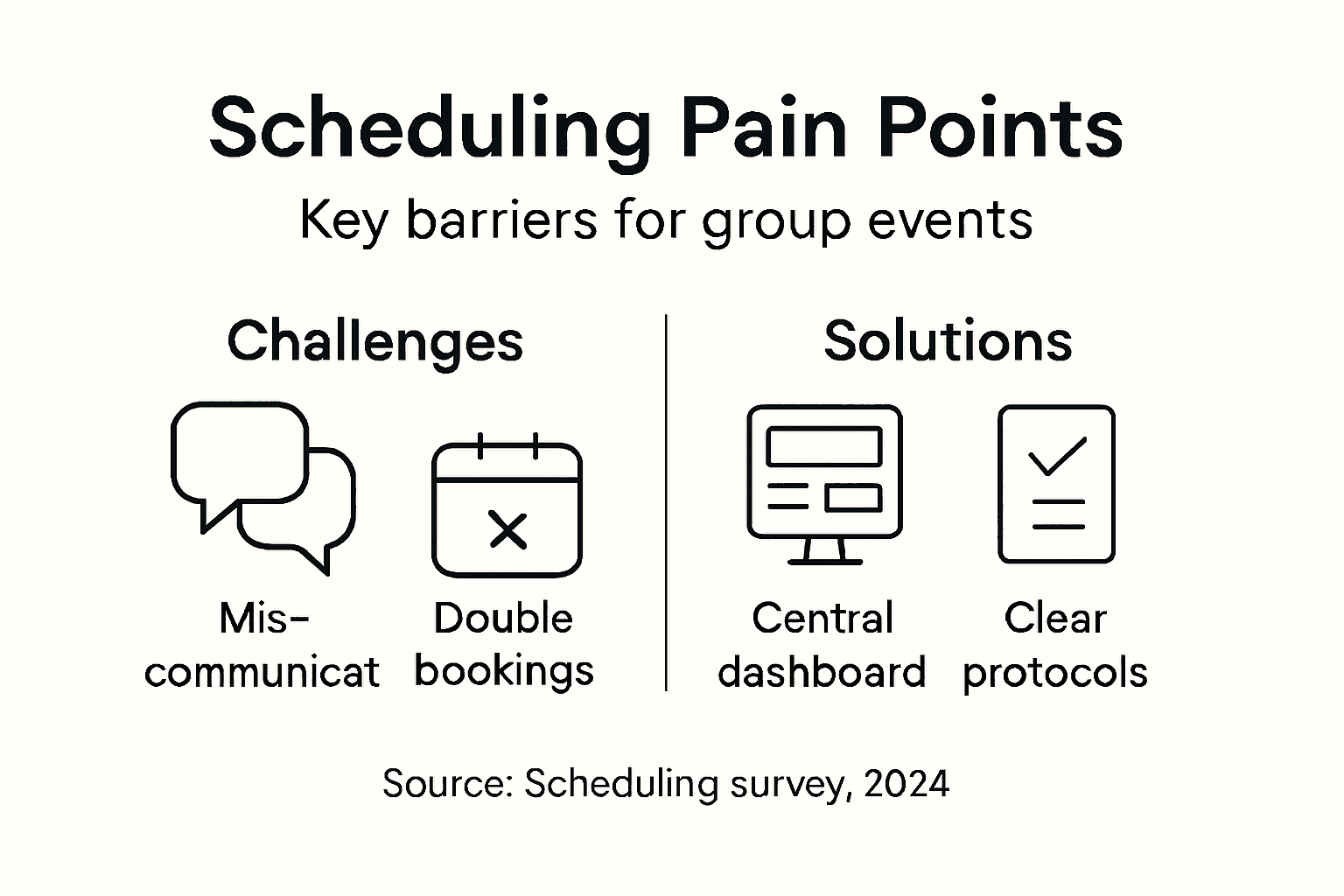
The core scheduling pain points typically include communication breakdowns, lack of centralized scheduling mechanisms, time zone differences for remote teams, and insufficient visibility into participants' actual availability. Each of these challenges creates exponential complexity that can consume significant administrative time and resources. Academic event planning research suggests that without robust coordination strategies, organizations can lose substantial productivity navigating these scheduling obstacles.
Here's a comparison of scheduling challenges and their potential business impacts:
| Challenge Type | Description | Business Impact |
|---|---|---|
| Communication Breakdown | Unclear updates or misalignment | Missed deadlines, increased errors |
| Decentralized Decision | Multiple approval layers | Slow responses, project delays |
| Time Zone Differences | Distributed teams in various zones | Reduced overlap, rescheduled tasks |
| Limited Availability | Conflicting participant schedules | Lower attendance, strained planning |
Pro tip: Implement a standardized pre-planning questionnaire that captures key availability constraints and communication preferences before initiating detailed event scheduling.
Types of Scheduling Challenges for Groups
Group event scheduling presents a complex landscape of challenges that span logistical, financial, and interpersonal dimensions. Conference scheduling challenges reveal intricate obstacles that can derail even the most meticulously planned gatherings.
The primary types of scheduling challenges can be categorized into several critical areas. Logistical challenges include managing participant availability, coordinating multiple calendars, and addressing time zone differences for distributed teams. Financial constraints emerge through resource allocation complexities, where budget limitations intersect with scheduling requirements. Stakeholder coordination represents another significant challenge, involving the delicate process of aligning diverse individual schedules, departmental priorities, and organizational goals.

Furthermore, track-based scheduling problems highlight specific technical challenges such as avoiding parallel session conflicts, managing presenter availability, and optimizing resource utilization. These challenges become particularly complex in large group events like conferences, academic symposiums, and multi-day corporate retreats where numerous moving parts must be synchronized simultaneously.
Pro tip: Create a comprehensive scheduling matrix that maps individual availability, critical constraints, and potential conflict zones before finalizing any group event timeline.
Key Characteristics of Multi-Day Event Coordination
Multi-day event coordination represents a sophisticated planning challenge that demands intricate strategic management across multiple dimensions. Extended logistical complexities require event planners to develop comprehensive approaches that go far beyond traditional single-day event scheduling.
The key characteristics of multi-day event coordination involve several critical components. Resource management becomes paramount, with planners needing to maintain consistent vendor relationships, balance participant engagement, and create flexible scheduling frameworks that can adapt to unexpected changes. Participant experience design emerges as a crucial consideration, requiring careful attention to energy levels, networking opportunities, and sustained interest across consecutive event days.
Multi-day event planning demands sophisticated sequencing strategies that balance structured programming with organic interaction opportunities. This involves creating nuanced schedules that include dedicated networking periods, strategic break intervals, parallel track management, and mechanisms to prevent participant fatigue. Successful coordination requires anticipating potential scheduling conflicts, managing transition periods between sessions, and maintaining a holistic view of the event's overall flow and participant experience.
Pro tip: Develop a dynamic scheduling matrix that includes buffer times, contingency plans, and clearly defined transition protocols to maintain event momentum and participant engagement.
How Scheduling Pain Points Affect Group Event Success
Scheduling challenges have far-reaching consequences that can fundamentally undermine the entire group event experience. Scheduling friction directly impacts event outcomes by creating operational inefficiencies, reducing participant satisfaction, and increasing overall organizational stress.
The cascading effects of scheduling pain points manifest through multiple critical dimensions. Participant engagement drops dramatically when events lack smooth logistical coordination, leading to frustration and reduced information retention. Financial implications become substantial, with last-minute changes and poor scheduling potentially increasing operational costs by creating unnecessary complexity, redundant communication, and inefficient resource allocation.
Event planning challenges reveal that unresolved scheduling issues can permanently damage professional reputations. Organizations risk creating negative perceptions among participants when events appear poorly organized, with rushed agendas, unexpected conflicts, and inadequate transition management. These systemic problems transform what should be productive gatherings into exercises in collective frustration, ultimately undermining the core objectives of group events.
Pro tip: Implement a comprehensive pre-event scheduling audit that identifies potential conflict zones and develops contingency strategies at least two weeks before the event kickoff.
Solving Common Scheduling Mistakes and Delays
Group event scheduling demands strategic interventions that preemptively address potential disruptions before they cascade into complex problems. Proactive event planning strategies require systematic approaches that minimize scheduling friction and maximize organizational efficiency.
Addressing scheduling challenges involves multiple tactical interventions. Organizations must establish robust communication protocols, implement detailed timeline tracking, and create flexible contingency frameworks. Key strategies include developing comprehensive budget plans, establishing clear vendor communication channels, and integrating regular team check-ins to monitor potential scheduling conflicts. Buffer periods become critical in managing unexpected complications, providing necessary flexibility to accommodate last-minute adjustments without derailing entire event timelines.
Advanced scheduling technologies offer sophisticated solutions for mitigating scheduling errors. Artificial intelligence-powered scheduling tools can automatically optimize resource allocation, reduce human error, and provide real-time coordination updates. These technologies enable precise time management, facilitate cross-team communication, and create transparent scheduling environments that minimize misunderstandings and potential conflicts.
Pro tip: Create a centralized scheduling dashboard that provides real-time visibility into all event planning components, allowing immediate identification and resolution of potential scheduling conflicts.
Below is a summary of solutions and the event planning pain points they address:
| Solution Strategy | Addresses | Key Benefit |
|---|---|---|
| Pre-planning Questionnaire | Conflicting schedules | Faster availability identification |
| Centralized Scheduling Dashboard | Overlapping calendars | Real-time schedule visibility |
| AI-Powered Scheduling Tools | Human error, delays | Streamlined coordination, fewer errors |
| Buffer Periods/Contingency Plans | Unexpected disruptions | Easier handling of last-minute issues |
Overcome Scheduling Pain Points with WhenNOT for Effortless Group Event Planning
Scheduling conflicts and coordination challenges can quickly turn group event planning into a stressful experience. The issues touched on in the article like overlapping calendars, decentralized decisions, and limited availability are exactly why a smart, streamlined approach is essential. WhenNOT’s unique inverse scheduling method lets participants mark when they are not available rather than when they are free. This drastically reduces back-and-forth communication and uncovers the best possible dates for multi-day or flexible events.
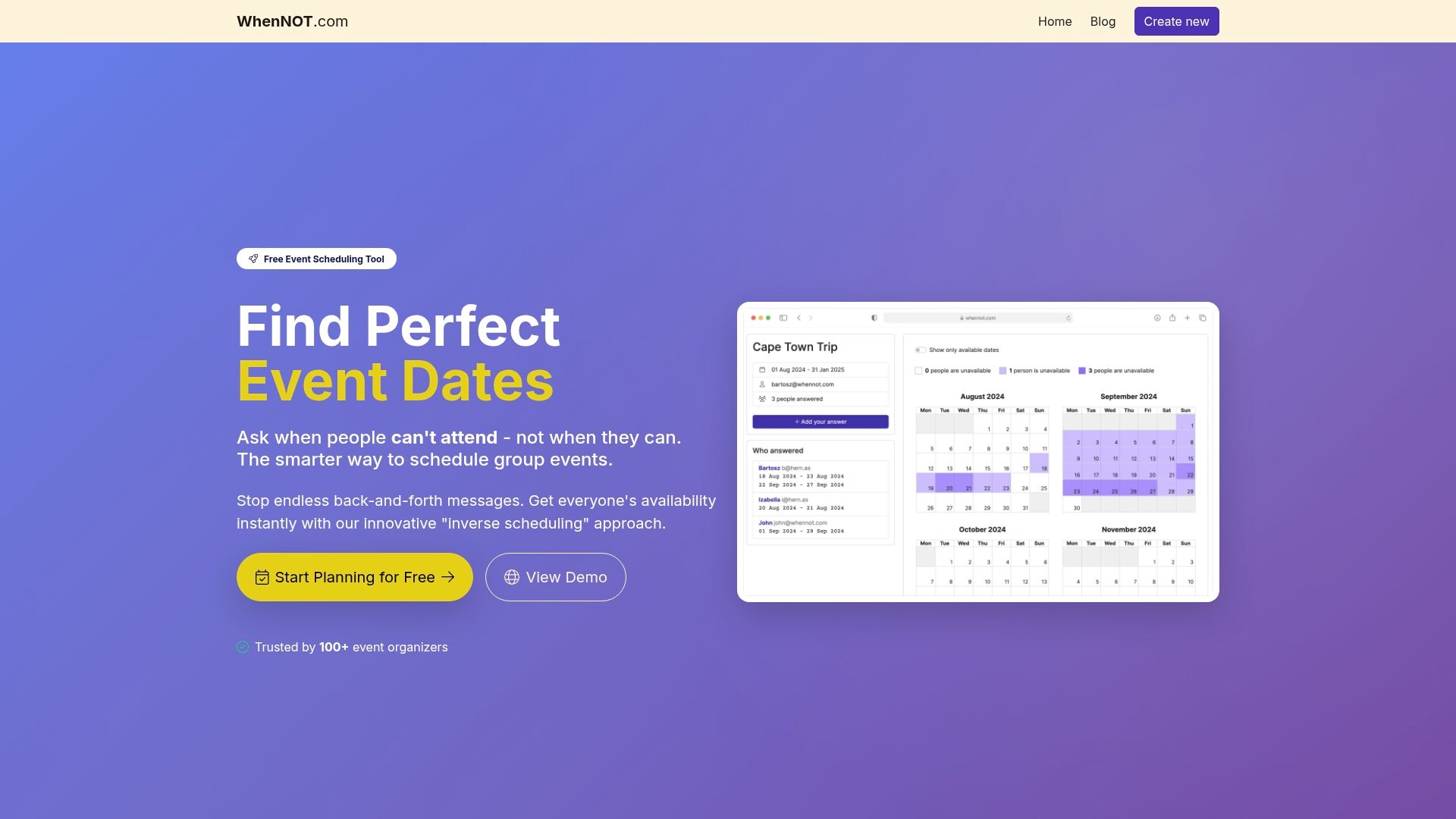
Take control of your event timeline now with WhenNOT and experience the difference a tool designed for group efficiency can make. Whether you are managing a corporate retreat or a family reunion, you will save precious time and reduce frustration by visualizing everyone’s blocked times in one centralized place. Start simplifying your scheduling today with this easy-to-use platform and banish common event planning delays for good.
Frequently Asked Questions
What are common scheduling pain points in event planning?
Common scheduling pain points include communication breakdowns, decentralized decision-making, time zone differences, and limited participant availability. These issues can complicate the coordination process and create operational inefficiencies.
How do scheduling challenges affect group event success?
Scheduling challenges can lead to reduced participant engagement, increased operational costs, and damage to professional reputations. Poorly coordinated events may frustrate attendees and detract from the overall objectives of the gathering.
What strategies can help mitigate scheduling issues for group events?
To mitigate scheduling issues, organizations can implement robust communication protocols, use centralized scheduling dashboards, develop comprehensive pre-planning questionnaires, and leverage AI-powered scheduling tools for real-time updates.
Why is it important to have a centralized scheduling system?
A centralized scheduling system provides real-time visibility into all event planning components, making it easier to identify and resolve potential scheduling conflicts quickly. This can enhance coordination and minimize delays during the event planning process.